
Wid Gunning and Wid’s Film and Film Folk, on Productions from the “Flying A”
Brian N. Cary, March 2008
Abstract
The “Age of the Silver Screen,” was in full stride in 1915 when then twenty nine year old, Wid Gunning, began circulating Wid’s Films and Film Folk, a weekly newspaper periodical dedicated to all things motion picture. Throughout its press life from September 9, 1915 through April 30, 1919, Wid’s Film and Film Folk reviewed over fifty American Film Company pictures, helping to throw a much deserved spotlight on one of the most succesful and influential film companys of the silent film era.
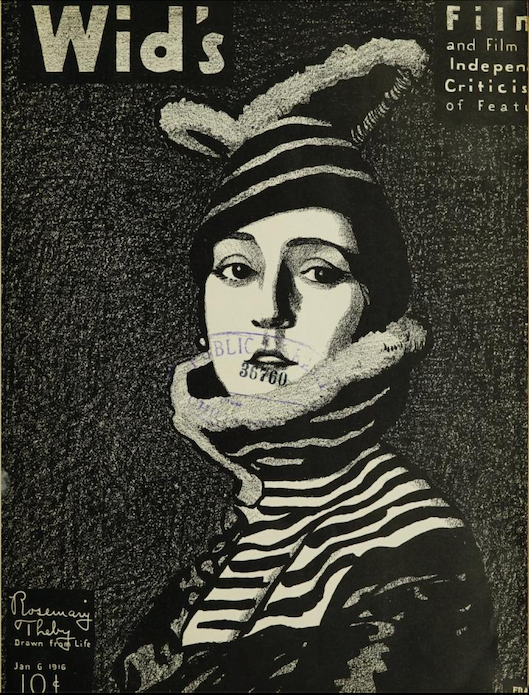
The “Age of the Silver Screen,” was in full stride in 1915 when then twenty nine year old, Wid Gunning, began circulating Wid’s Films and Film Folk, a weekly newspaper periodical dedicated to all things motion picture.
A self-labeled “Independent Guide For Film Fans,” Wid’s was sold in cities across the United States for a yearly subscription fee of $5.00. Gunning hoped that fellow film fanatics would “rally with enthusiasm to the support of a publication which gives honest, unbiased reviews of current feature offerings.” Released weekly, Gunning began circulation of his film review magazine on Thursday, September 9, 1915, when the first issue of Wid’s Film and Film Folk hit the streets.

Born January 30 1886, in Chillicothe, Ohio, Wid became involved in the film industry early on in his life, trying his hand at various aspects of filmmaking. Wid Gunning was certainly a man who loved films, and one who took his craft very seriously. When Gunning decided to begin printing Wid’s, he was not the first to be “journaling” film reviews. Review periodicals such as TheMoving Picture World, had already been in circulation prior to the introduction of Wid’s. Gunning, however, was first and foremost a film fan. It was this attitude that made Wid’s such a unique, and over time respected, film review source. Gunning was adamant about refusing any and all advertising that might pose a threat to the honesty and reliability of his independent reviews. He communicated clearly his commitments to his readers, in his first ever issue of Wid’s Film and Film Folk:
“ This publication is for the fans, first, last, and all the time. Advertising will be accepted, but never with any inference or suggestion of editorial favor. This publication is dedicated to the betterment of films. It shall exist through the support of his readers or not at all. I am making here an appeal to every friend of fine films to rally to my support. I control this publication, lock stock and barrel, and shall at all times be on the side of the fans.” (Wid’s Vol. 1, Issue 1, p. 1)
Between 1915 and 1919, major production studios such as American, Fox, and Universal, were under huge pressure to deliver an increasingly large amount of motion pictures. The American public had transformed, in an amazingly short period of time, into an audience who consumed feature films almost faster than they could be produced. Delivering at times, two pictures per week, major motion picture studios insured that the market would never cease to be saturated with new and available pictures. This strategy inevitably meant the release of sub-par productions by major names in the film business.
Wid’s Films and Film Folk served as a weekly guide that Gunning provided as a means of wading through this barrage of film product. Gunning helped filmgoers to pick out films that would be worth their time, and help direct them away from films that had been hastily thrown together to make a quick buck. Though his primary audience was the movie-going public, Wid’s also worked as a guide for theatre owners. Gunning included a segment in Wid’s titled “The Box Office Perspective,” a section that emphasized the “playability” of particular feature films – focusing less on reviewing the actual quality of the film and more so on the ability of the picture to keep theatre seats filled. Obviously, there was a certain degree of correlation between the two; a well-made film will generally sell more seats than a poorly made one.
Though Gunning’s independent reviews of widely released, feature-length motion pictures, was the exclusive focus of his periodical, Wid’s contained a varied selection of news and bibliographic type pieces on famous directors and popular silver screen stars. Wid’s even featured a write-in section, a page Gunning dedicated to answering any questions that his readers might have about anything relating to film. Gunning wanted to provide his avid readers and fellow film fans the “little squibs of information which make for a better understanding between you fans and the people who spend their days and nights to educate and entertain you.” The purpose and function of Wid’s was clearly to enhance the movie-going experience. It’s long publication life and wide circulation attest that it must have done just that. Wid’s would entertain three different publication titles throughout its lifespan, becoming Wid’s Independent Review of Feature Films in 1916 and finishing as Wid’s Daily in 1919.
Gunning’s film reviews and articles were truly done in a “by fan – for fan” fashion, one made apparent in every page of his conversational-style writing. Part of the attraction of Wid’s was Gunning’s frank manner of speaking, both about films that he enjoyed and those that he did not, a style of writing that proved a seamless fit for reviewing films. Gunning’s reviews, though not always positive, nonetheless appeared non-authoritative and conversational, providing readers with a sense of confidence that they were not being talked down to, nor were they being force-fed an unequivocating mandate of film do’s and don’ts. Gunning, a good-looking man himself, promoted an image of Wid’s as a magazine for the “smart moviegoer,” an honest insider account of the newest silent films to hit the screen, a must-have for anyone wishing to know the latest about the best the industry had to offer.
Though Hollywood would eventually become the self-proclaimed capital of film, it was Santa Barbara that sometimes played host to the best the film industry had to offer. Gunning reviewed the major film releases of the silent era, a number of which were shot and produced by studios outside of Hollywood.
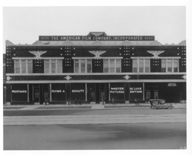
A major producer of silent films in the United States had long been The American Film Company, a Chicago based company that began production in the fall of 1910, with a studio in Santa Barbara by July 1912. Known throughout the film world by its nickname, “The Flying A” had catalogued five years worth of silent pictures before Wid Gunning even began to release his weekly review editorial. Throughout its press life from September 9, 1915 through April 30, 1919, Wid’s Film and Film Folkreviewed over fifty American Film Company pictures, helping to throw a much-deserved spotlight on one of the most successful and influential film companies prior to the 1920’s.
Prominent American Film Company Films Reviewed Within Wid’s Film and Film Folk
Infatuation (1915): The first American film to be reviewed by Gunning, in his first ever issue of Wid’s Film and Film Folk, was the 1915 release Infatuation. Produced by American and distributed by Mutual, Infatuation received high marks in all eleven categories of Gunning’s film ratings index. Raving of the film’s “humanity,” Gunning noted that the lighting was “exceptionally good,” the story “human,” the star (a rising Marguerita Fischer) received a mark of “splendid,” and on the whole, Gunning found the offering “convincing.”
Wid’s informed readers that they would surely appreciate this romantic drama about love and life in the theatre business. Directed by Harry Pollard (who also starred in the film), Infatuation brought a sense of realness to the screen, a tribute to a sophisticated script unlacking in its most important feature, the ability to “ring true.” This outstanding feature is commented on by Gunning in his review. He notes, “It is built around a story that might happen any day and has happened often… the action rings true all the way.” Gunning adds, “The story and Marguerita (sic) Fischer make this film… I am sure you will like Infatuation very much.” – See Infautation score card.

With this review, Wid Gunning and The American Film Company began a long and eventful relationship as film production company and film critic. Though the reviews were most often, but certainly not always, glowing, they were, at all times, honest. Wid Gunning was certainly one critic whose respect could only hope to be gained through stepping up, and refusing to take the easy way out when it came to good filmmaking. Wid’s Film and Film Folk reviewed many other American pictures after the release of Infatuation. Here is a look at some of American’s most important feature releases:
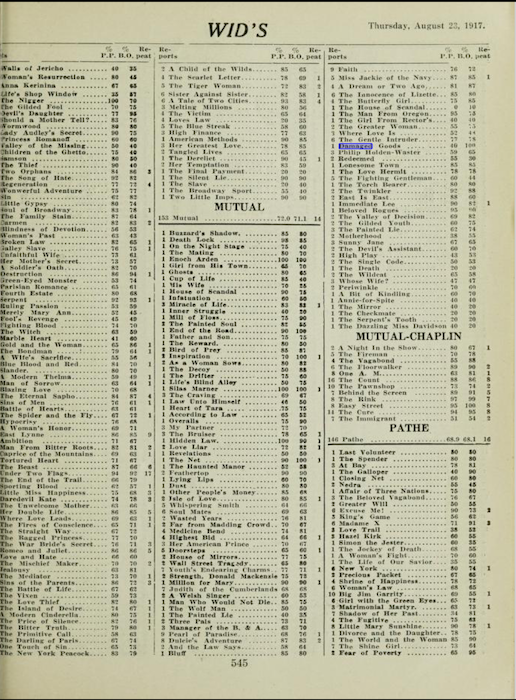
Damaged Good’s (1915): Appearing in Wid’s Issue #4, was a review of the American picture Damaged Good’s, starring Richard Bennett and Adrienne Morrison that originally released in 1914. Receiving a more ecstatic review than even Infatuation, which was highly recommended, Damaged Good’s was the film adaptation of the stage play of the same name, which, also starring Richard Bennett, stopped showing in 1914. The film in 1915, then, was a welcome twist for fans wishing to see the story performed on the big screen. Gunning, along with audiences everywhere, were blown away by the film’s powerful story about a young man’s life changing experience with syphilis. Wid’s noted that, “it is a lesson that will carry more conviction than thousands of sermons… Go see Damaged Goods.”.
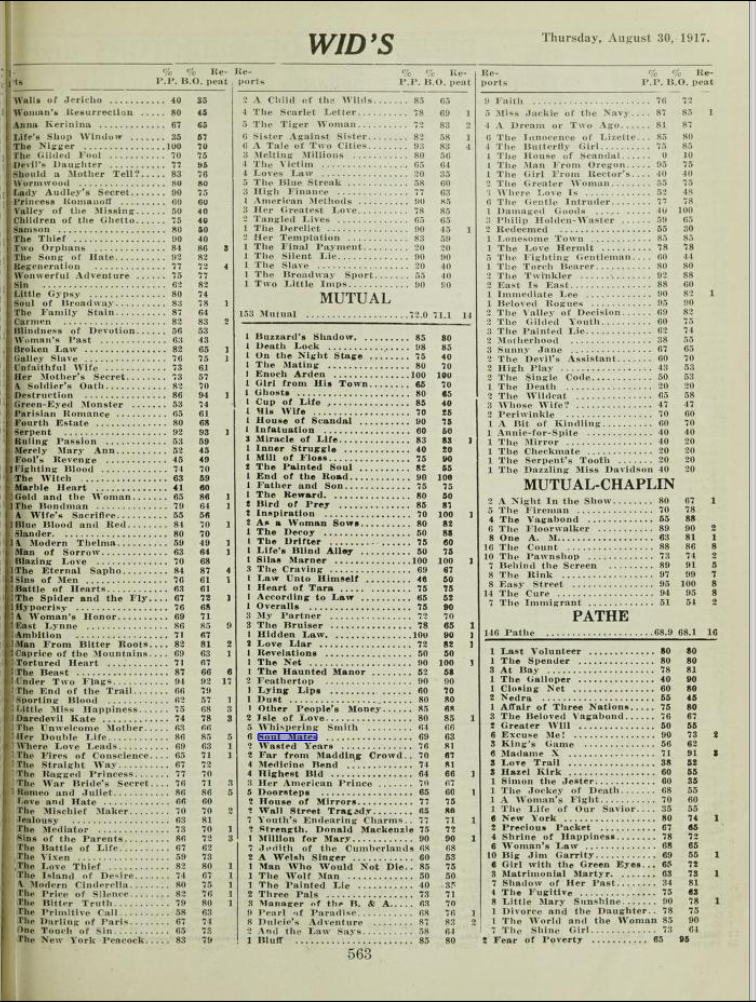
Wid Gunning was a man who prided himself on the honesty and integrity of his reviews. This being said, it would have been impossible for Gunning to provide ecstatic reviews of all the films which he came across, while still maintaining his objective stance as a non-biased film critic. Though many of the American releases reviewed by Gunning received high and even outstanding marks, there were inevitably several titles that Gunning found to be lacking in some respect. They were not all breath-taking cinematic masterpieces, so to speak. Gunning’s review of the 1916 release Soul Mates, is a perfect example. While his review notes that the story for this American Film has been perhaps too overused, Gunning is able to separate this damaging element from the exceptional work of the American crew.
Soul Mates (1916): This release in May of 1916 received fair marks for its actual story, yet its faults were no match for the talent of its cast and crew, ensuring the picture high ratings in all but two categories. As a whole, the picture was found to be “rather well-done,” despite remarks of a hackneyed and overplayed story. Gunning comments that William Russell’s convincing performance as the “big, good-looking hero” save this American Production from being classified in the ordinary. He also notes that “there were a number of decidedly beautiful exteriors, which helped raise the general caliber of this offering.” Though the story was somewhat lacking in fresh content, the outstanding performance of a convincing cast and dedicated crew, made this American release a worthwhile venture.
Purity (1916): This July 1916 feature received outstanding public attention, both for its artful direction and for its controversial nude scenes, featuring a stunning Audrey Munson. A six part full feature film, American released Purity, a story of a young poet and his beautiful lover who poses nude to raise the money for her love’s work to be published. Purity was a film cookie-cutter fit for Audrey Munson, one of the most famous artists models of the era. But, as Gunning would reiterate in Wid’s Film and Film Folk, American had done more than to simply put a pretty face up on the big screen. While noting that a primary attraction to the film would surely be that of the nude scenes of Ms. Munson, he also noted the excellent caliber of production work on the title. He jokingly notes “ they figured out every way possible for Ms. Munson to show what she has. From that viewpoint the production is quite complete.” Gunning, however, also recognized the serious work that had been done on the film, and rewarded it with high marks for both cinematography and cast performances. “The film has been well made… and the whole has been hung together sufficiently well…” – See Purity scorecard.

Dulcie’s Adventure (1916): This was one American film that did not receive Gunning’s stamp of approval. When this Drama about a wealthy Southern aristocratic family fallen on hard times opened in cinemas on October 2, 1916, the review was extremely critical. Gunning faulted American for wasting money on poor scenarios and poor direction. James Kirkwood, apparently, had not impressed. With a story described as “painfully poor action” and “most ordinary,” this film about wealth and love failed to capture audiences at the box office. Gunning notes that human touches seemed to be replaced by melodramatic action, emphasized again in part of the headline of the review, “Melo Action Crude.” Mary Miles Minter was noted the only high point of the film, a “distinctive personality,” that was “wasted in such a manner.” Even beautiful close-ups of the American star could not save this picture from the poor review it received.
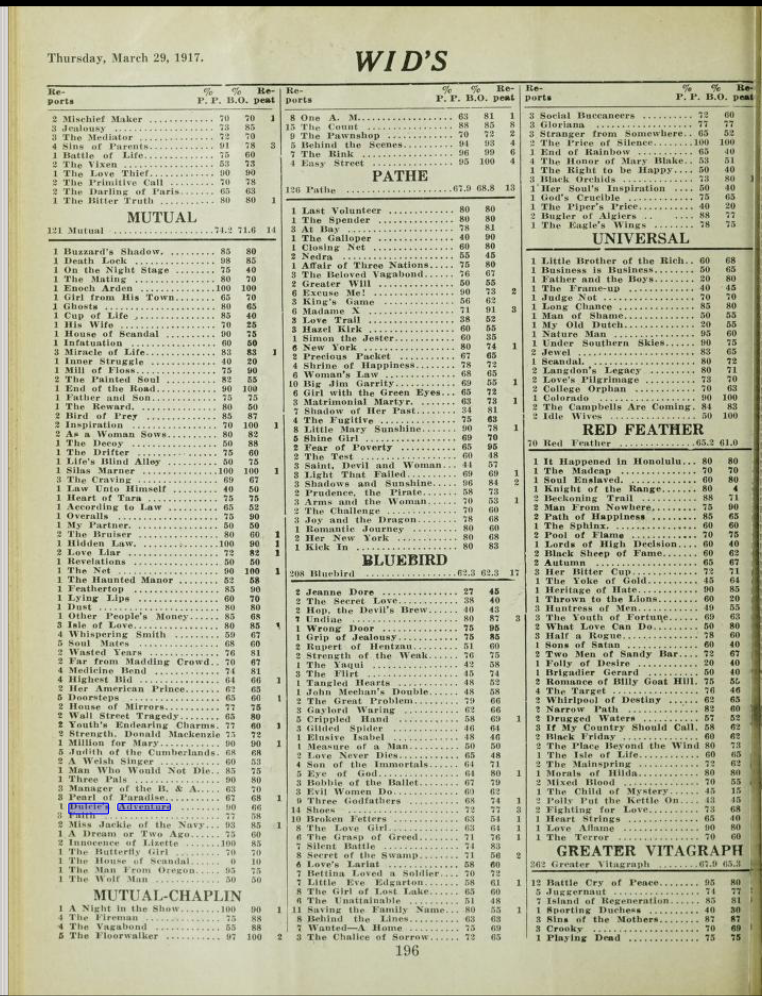
Philip Holden-Waster (1916): When this film released on October 9, 1916, Wid’s review three days later had nothing but good things to say about this entertaining drama. The story of a poet fallen in love was directed by George Sargent and starred Richard Bennett, now a staple of the Flying A’s star ensemble. Receiving high marks in every category of Gunning’s review criteria, with special note to a story reviewed as “fine characterization: kept convincing,” and a star who portrayed “truly human characterization,” Holden-Waster was raved about as a purely entertaining joy to watch. The first words of the review highlighted this. “As entertainment this ranks very high.” Gunning goes on to appreciate the ability of the film to makes audiences care about and feel connected with, the central character. He notes that, “by many human touches which were well directed and particularly well played by Mr. Bennett, we seemed to ‘know’ this character.” Clearly admired by Gunning for its entertainment value, the all around solid review for Philip Holden-Waster was certainly that it was a worthwhile time out, another entertaining piece of cinema from The American Film Company. – See Philip Holden-Waster scorecard.

High Play (1917): When this film released on April 9, 1917, the reviews from Wid’s were nothing but ecstatic for this American Film Company drama, starring William Russell and directed by Edward Sloman. Gunning found this tale of bankruptcy, blackmail, and murder, to be a phenomenal action film, handled with care by the crew at American. Gunning remarks in his April 12addition of Wid’s that, “the story elements were smoothly developed… and the average film fan who likes an action plot will consider this quite worth while.” High Play received a positive mark in all of Gunning’s film review categories, noting the exceptional performance of Russell who was decidedly “impressive” and “forceful.” Gunning commented further in the bulk of his review on Russell’s performance, and its ability to lift High Play to a greater level. He remarks, “William Russell was the dominant figure all the way, and this big, six-foot boy has a sort of human personality that keeps his characters from appearing very “actory.” He knows how to hold a scene right well, and there were many very good dramatic pauses in this.” With an eventful story, and a powerful performance by both the lead roles and supporting cast, High Play received the approval of Wid’s, which gave audiences everywhere a half-page long reason to go out and see it. – See High Play corecard (fix).

In Bad (1918): On January 14, 1918, American released In Bad, a comedy-drama that again saw the pairing of William Russell in the leading role, with Edward Sloman once again in the director’s chair. Gunning’s review of In Bad found that the film itself was far from it. Infact, Gunning gave the film rave reviews, only pausing very briefly in his praise to draw attention to a few “bad angle shots.” This tale of a young boxer unwilling to settle down had Gunning smiling for all five parts of this fifty-seven minute, American feature. As per usual, Gunning’s title for his review summed up his position quite nicely. “Good Comedy Drama With Star Scoring Strongly.” Gunning notes Russell’s ability to “get any number of laughs,” and concludes that the picture was “well handled” overall. Clearly another quality offering by American. – See In Bad scorecard (fix).

A Bit of Jade (1918): The last American Film Company picture to be screened and reviewed by Wid Gunning in Wid’s Film and Film Folk, A Bit of Jade, starring the ever popular Mary Miles Minter, and directed by Edward Sloman, received warm reviews as a pleasing social-comedy. Released April Fool’s Day, 1918, A Bit of Jade tells the humorous tale of a necklace mix-up, and details the ensuing action between the separate parties. Gunning notes that the film’s detail and structure were especially well crafted. He remarks that, “the incidents all dovetailed without a hitch, with adequate explanations given for each occurrence.” As for the film’s star, the American poster-woman of Mary Minter, Gunning commented that it was a job well done (like usual). Minter did much to bring this social comedy to life, “doing a happy, care-free role which she carries through advantageously.” With direction from Sloman that kept the pace of the film interesting and with a talented Minter set against beautiful exterior sets, this American picture was an all-around success. – See A Bit of Jade scorecard (fix).

Wid Gunning enjoyed a long and eventful relationship with the American Film Company, publicly reviewing over fifty American films in Wid’s Film and Film Folk alone. Gunning was given the opportunity to sample the films of this non-Hollywood based film company, at a time when it competed at the level of much larger companies such as Fox and Universal. The American Film Company, with its offices in Chicago and Santa Barbara, still managed to release feature length motion pictures that rivaled and often times beat-out many of the Hollywood released pictures. Thanks to the genuine reviews of Wid Gunning and his various review periodicals, we have on hand a type of “historical report card,” a cataloging of many of American’s releases between 1916 and 1919, that can be quickly referenced in regards to directing, acting, set, and story evaluations. Wid’s Film and Film Folk worked to bring American pictures into the spotlight, recognizing it for its large number of quality offerings, and of course scolding it for the occasional theatrical dud. Honest and to the point, Wid Gunning was certainly a fan’s critic, and is remembered for his service to the motion picture world.