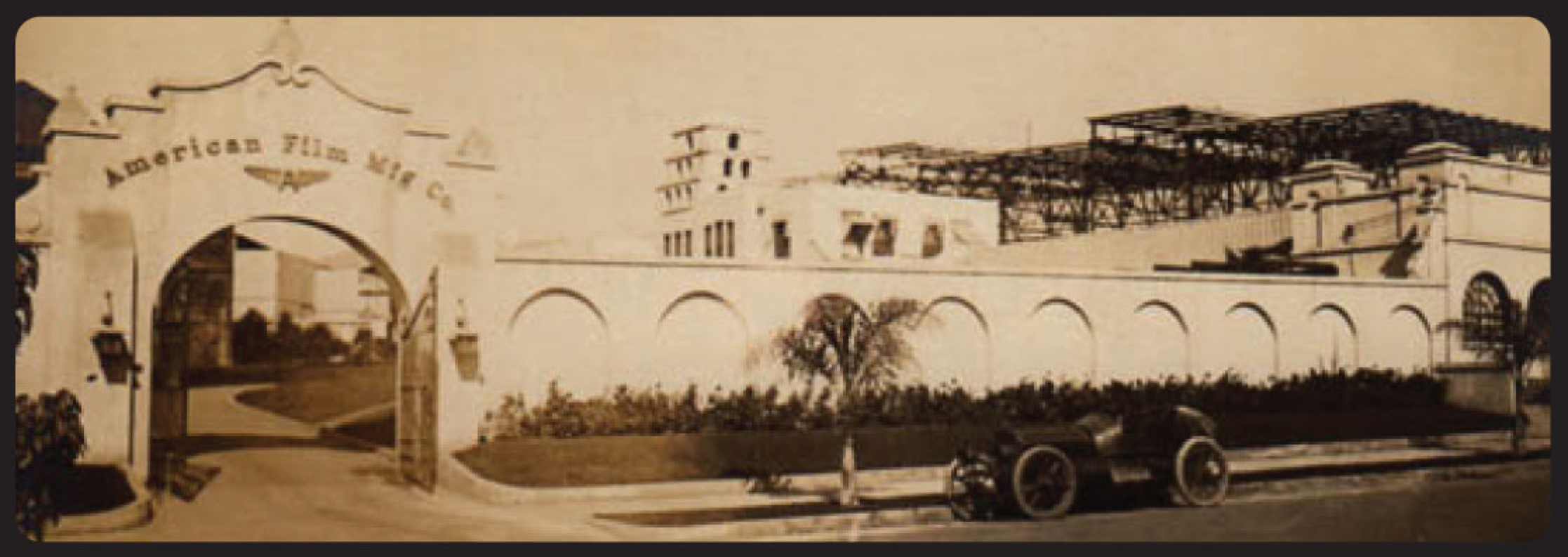
The American Film Manufacturing Company began in the fall of 1910 in Chicago. “Manufacturing” was dropped from the title in 1915, as the industry realized that the images on the film were more important than the film material itself.
Known by its trademarked nickname “Flying A,” the company began as an aggressive independent studio, at war with licensed competitors such as Biograph and Edison. It soon became a major force, alongside studios such as Metro and Universal.
There were four significant places in the company’s growth and prosperity.
Chicago, Illinois
The American Film Manufacturing Company was founded in Chicago. The Second City remained the company’s base of operations throughout its corporate life. Samuel Hutchinson, John Freuler, Charles Hite and Harry Aitken, four Midwestern exchangemen, joined forces and capital to create a production company to supply films to their various exchanges. Most of the first actors and crew came from Essanay and Selig Polyscope, two licensed production companies in Chicago. The Flying A initially filmed at a studio leased from the defunct Phoenix Company in the fall of 1910, but by early 1911, the well-financed American moved into its own studios. Three shooting units were created. Two worked at the studio or surrounding locales, while the third unit was sent out to film westerns. This unit moved through the Southwest with stops in New Mexico, Arizona and finally California. The unit eventually settled in La Mesa, California.By late 1914, production ceased in Chicago, as all filming centered on the company’s new facilities in Santa Barbara. Business activities, from release printing to promotion, remained in Illinois. Chicago’s significance was strengthened even further when American’s distributor, Mutual Film Corporation, relocated there from New York in 1914.American’s Chicago office oversaw a flow of films throughout the world and maintained additional offices in Paris and London.
Southern California and La Mesa
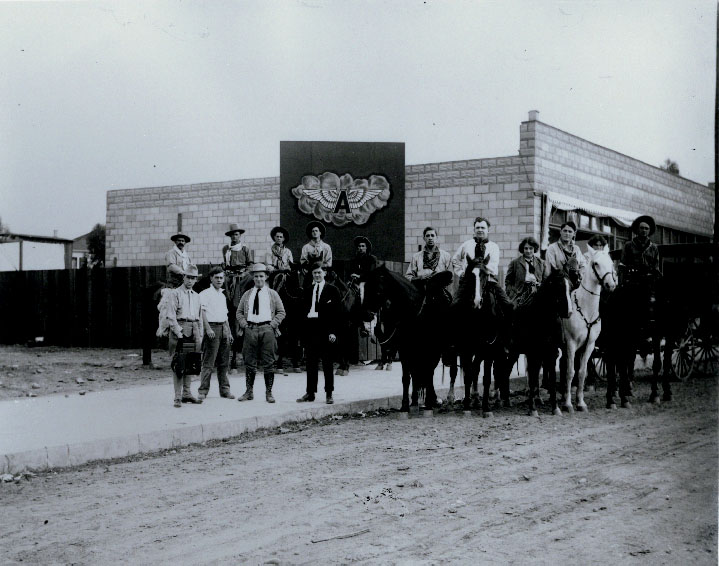
After initial production in the San Juan Capistrano area and a longer stay in Lakeside, the Flying A’s western unit, headed by Allan Dwan, established an office at La Mesa, California in 1911. Filming was done throughout the El Cajon valley. Nearby beaches were also used as settings for many of the one-reel movies, but La Mesa lacked enough urban and suburban locations and limited the range of scenarios.During this period fiction films were growing in popularity but nonfiction “topicals” still had a place in the market. American also produced such films as Winter Sports and Pastimes of Coronado Beach, A Midwinter Trip to Los Angeles, and Santa Catalina – Magic Isle of the Pacific. Sadly all three of these titles appear to be lost and this is the case for about 90% of American’s films.
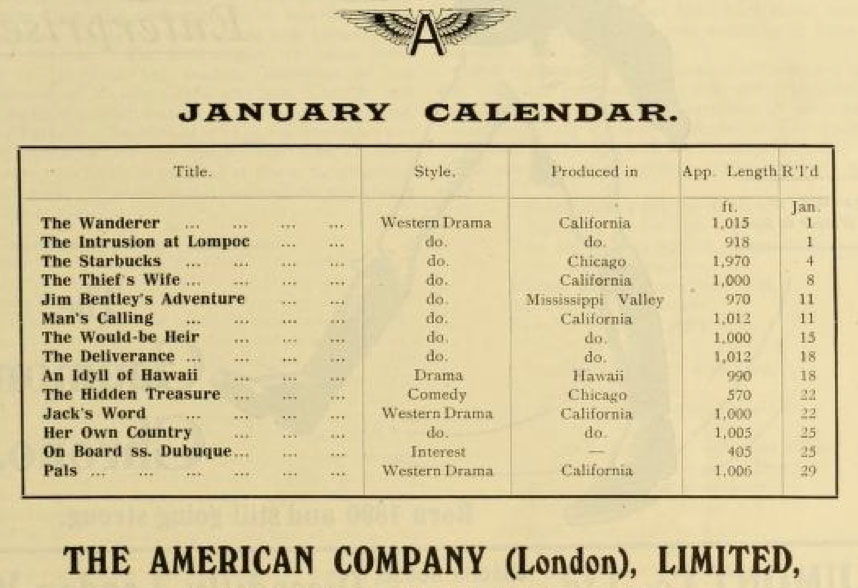
London, England
Although the Mutual Film Corporation handled American’s distribution for both the United States and Canada from 1912 to 1918, the American Film Company in London distributed the company’s films worldwide.The London office opened in 1911, but there was no studio and the office was merely a distributor. The large collection of films by American presently held by the BFI may be because the films at the London office were not returned to Chicago when the office closed in 1920.
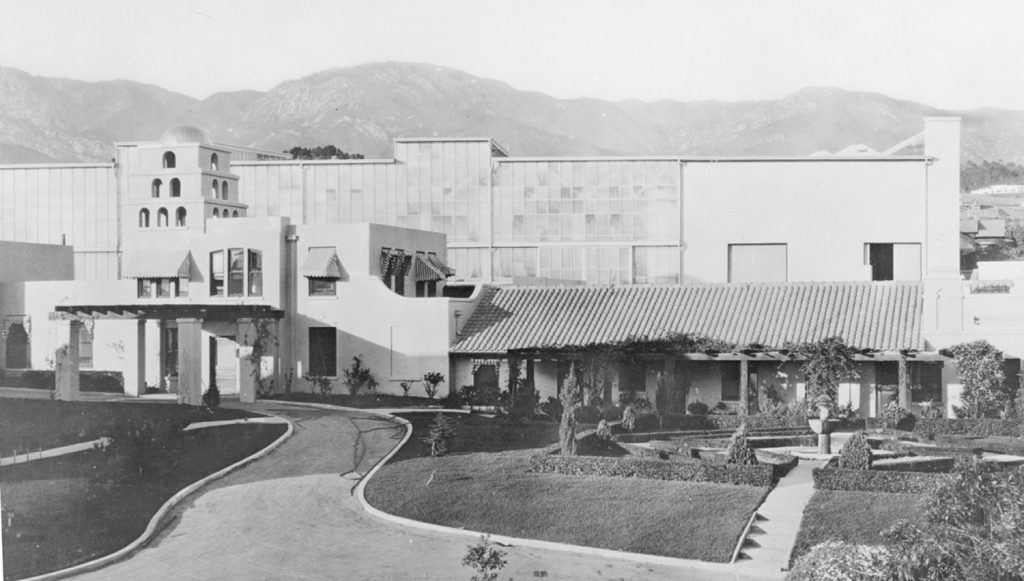
Santa Barbara, California
The Flying A arrived in Santa Barbara, California on July 5th, 1912, headed by Allan Dwan. The western company had already become a nationally known producer of nearly 200 films. Santa Barbara offered a tremendous variety of locales, both natural and constructed. The town had been used occasionally by other movie companies, but American settled there and invested in property to construct a permanent studio.The studio’s Mission-Revival style echoed the picturesque architecture of Santa Barbara’s train station and the prominent Potter Hotel. More importantly, the studio allowed the company to add personnel and increase movie production.Along with westerns, American established units to produce comedies, period dramas, adventure stories, and romances. At first these films were all one- and two-reelers, but in the fall of 1914, they released, Damaged Goods, a seven-reel social drama.By this time, many of the original staff had departed, replaced by such players as Harold Lockwood, May Allison, and Margarita Fischer. The studio was then the town’s largest employer, and flourished until the United States entered World War I in the spring of 1917.The war, the influenza pandemic and economic shifts within the film industry effected the Flying A severely though seventy-eight features were still to be produced and production would not end until 1920.