Confirmed Years: 1912-14
Biography:
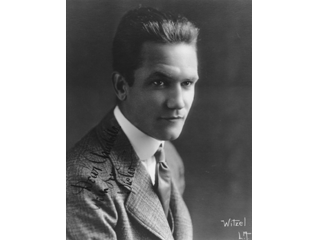
The titles Gone With the Wind and The Wizard of Oz are synonymous with the film world, but the name Victor Fleming is often lost in the history books. The director of said films carved a successful career for himself in Hollywood and proved to be very popular among actors and actresses alike. Not many know that Fleming actually started his film career at The American Film Company. And though his stint at The Flying A may have been rather brief, it was an important stepping stone for Fleming in learning the key tools of the trade, and meeting the right folk.
Given his successful career post-Flying A, it is understandable that certain individuals wanted to lay claim to his “big break” at The American Film Company; those individuals included the likes of director Allan Dwan and cinematographer Roy Overbaugh.
Before Fleming’s entry into the filming world, he briefly forayed into the world of aviation, along with his friend, Howard Hawks. Recalls Hawks, after a very close collision in an automobile race, the two confronted each other afterwards. “We went to have a couple of drinks and became very good friends… [we] built a couple of airplanes…Fleming started as an automobile mechanic, then he became a cameraman”. While Fleming’s story is not quite as simple as that, it is true that he had a passion for automobiles before he laid his hands on a motion picture camera.
Roy Overbaugh confers this account of Fleming’s pre-film life, telling in an interview of how “Vic worked for Clinton Hale…a wealthy Santa Barbaran” who lived in Montecito. In a conversation with Peter Bogdanovich, Allan Dwan recollects his first encounter with Fleming. With a need for a reliable car mechanic, Marshall Neilan directed Dwan to Montecito in 1912 to meet “a fellow that works as a chauffeur for a wealthy family”. And when Dwan finally met the illustrious mechanic/chauffeur, he saw a stack of photographic equipment, and (according to Dwan), asked Fleming if he would be interested in entering “the motion-picture business [to] be a photographer?” As Dwan retells it, “he joined us, and became a very good friend of mine…He learned the camera very quickly”. Of all the accounts, this is probably the most notorious, most likely because of Dwan’s fame and the fact that he tells it so well.
The other, less detailed accounts come from various sources. According to Roy Overbaugh, it was very simple; “he came to the studio many times and wanted to know if [I could help him] get in the picture business. So, eventually, I worked it and Vic came on”. However, Leontine Birabent- Overbaugh’s girlfriend of the time- remembers it differently, because “Charlotte Burton, an actress at The Flying A, was dating Fleming at the time (and no doubt had a hand in bringing Fleming to the fore)…probably each one of them saw it in their own way”.
Once his foot was in the door, Fleming soon became camera assistant to Roy Overbaugh, in addition to R.D. Armstrong. The chief camera operator at the time recalls that “we worked together for some time, and eventually I went away with some company and Vic remained here, and then I believe he became first cameraman”.
Operating a camera that would have cost approximately $1500 of the time, Fleming did not stay at the Flying A for long. In 1914, the newborn Santa Barbara Motion Picture Company raided Lorimer Johnston, Scott Beal, Aubrey Kennedy and assistant cameraman Victor Fleming, among others. The company offered the promise of feature films for Fleming, beginning with the four-reel picture The Envoy Extraordinary, although after that they settled in to two-reel films, until “the company disappeared soon after the collapse of [their distributor] Kriterion Film Service in 1915”
Fleming went on to bigger and better things. Soon Fleming moved to Los Angeles to eventually work with the legendary Douglas Fairbanks and go on to reach arguably the peak of his career, Gone With The Wind in 1939. Fleming died in 1949 at the age of 60.
Sukhraj Singh
Film and Media Studies 181
March 25, 2008
Bibliography
NOTICIAS Santa Barbara Historical Society; Vol. XXII, No. 3; 1976
Bogdanovich, Peter; Who the Devil Made it: Conversations with Legendary Film Directors; Ballantine Books; 1997
Starr, Kevin; Material Dreams: Southern California Through the 1920s; Oxford University Press; 1991
Birchard, Robert; Silent-Era Filmmaking in Santa Barbara; Arcadia Publishing; 2007
Santa Barbara Morning Press, Various editions: 1912-13