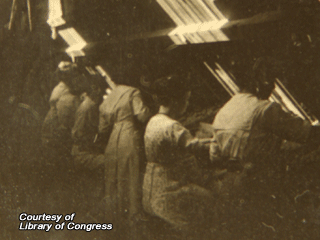
Documentary shot in Goleta about the extensive walnut ranches of the valley showing the picking, processing and loading onto railroad cars. “About fifteen scenes were taken, showing the walnuts from the time they drop from the tree, through the sorting and packing stage at the Goleta storehouse, until placed on a car, ready for shipment to the eastern market.” - The Morning Press, January 12, 1913, p.1. Also found in Moving Picture World, February 8, 1913, p.559 and Motography, February 15, 1913, p.122 “…a good line up of wagons to deliver walnuts was shown, also the emptying of walnuts into the hopper bins. The walnuts were then shown passing through the bleaching process, graded by the girls, sacked by the men and then handled on the way to the car.” - The Morning Press, November 16, 1912, p.3
Split reeler with "His Old-Fashioned Mother".
1. The film was two hundred feet in length. - Motography, February 1, 1913, p.106 2. An article written before filming discusses behind the scenes info and a future plan for the film: “…ranchers who can delay shipments to the storehouse or otherwise find it convenient to make deliveries at that hour are requested to do so, as it would add materially to the picture. …The work of harvesting the nuts will also be shown. Much of this has already been done, but there is still considerable activity on the big ranch of the Goleta Walnut company, closer to the mountains, which, because of its location, is always a couple of weeks behind the other ranches. Mr. Hutchinson is very much interested in various activities he has noticed about Santa Barbara, and has instructed his force here to not overlook any opportunities to show them in moving pictures. Some of these pictures will be shown under the Flying A trademark, while others will be sold to the companies specializing in news films. This will also fit nicely into the movement started to show Santa Barbara county in moving pictures at the 1915 San Francisco fair. Such pictures as the American will be making will later be available for that purpose at much less cost than if they were specially made for the exhibit.” - The Morning Press, November 13, 1912, p.3 3. Ranchers were asked to make their deliveries during filming “so that a lively scene can be chronicled by the moving picture camera.” - The Morning Press, November 14, 1912, p.3 4. Filming began on November 14, 1912, and on November 15, 1912, scenes were shot at the Goleta storehouse. “Phillip Marble, superintendent of the storehouse, has already made arrangements for half a dozen ranchers to be on hand… so that there may be a good supply of the crop to be put into action.” - The Morning Press, November 15, 1912, p.5 5. Scenes were also shot on the John. F More ranch, and “Hutchinson was assisted… by Wallace Kerrigan and R.D. Armstrong, who operated the camera.” - The Morning Press, November 16, 1912, p.3 6. Advertised as “A meritorious educational subject.” - Moving Picture World, January 11, 1913, p.116 7. After the film’s release, Hutchinson had some thoughts about future industrial and agricultural documentaries: “’The people of the cities are turning their attention to the land… The movement is stronger than may appear out here. The people of the cities are anxious to know how things are done out in the great, free country and it will be the purpose of the American Film company in the future to overlook no opportunity to let them know. We hope to produce films that will go into the minutest details, taking the spectator through various stages of work.’” - The Morning Press, January 21, 1913, p.5 8. After the film’s release, walnut prices soared to never before seen figures in Chicago, as high as sixty cents a pound. “It was facetiously remarked last evening that the American Film picture of the Goleta walnut industry, released a month ago, may partly be responsible. That picture has been shown all over the country, and the fine views of orchards and methods of handling the walnuts on the way to market, may so have created walnut appetites that a sudden demand resulted. Probably the moving picture fans have become walnutty. Anyhow, walnuts are selling for more than a cent apiece.” - The Morning Press, February 13, 1913, p.8 9. “The Walnut Industry” began showing at the Palace Theatre in Santa Barbara on February 27, 1913. - The Morning Press, February 26, 1913, p.8 10. Another film, this one a fictional story, was going to be made about the walnut industry. Lorimer Johnston and Hutchinson visited the Goleta walnut house “and made a thorough inspection of the place with a view of using it for the making of a picture. It is planned to use the interior with the girls at work and other interesting features.” - The Morning Press, November 14, 1913, p.2 11. Flying A’s agricultural films were shown at Santa Barbara County’s exhibit at the Panama-Pacific International Exposition in 1915. Scenes featuring the walnut industry were to be played for the chamber of commerce at a banquet as part of planning for the 1915 Fair. - The Morning Press, December 7, 1913, p.3 and The Morning Press, March 23, 1915, p.6 The English Walnut Industry was a split reeler two hundred feet in length that depicted the activities of Goleta’s walnut ranchers.1 During filming, which took place in November of 1912, ranchers were asked to bring their walnut deliveries to the Goleta storehouse “so that a lively scene can be chronicled by the moving picture camera.”2 Phillip Marble, the superintendent of the storehouse who later became president of the local Walnut Growers Association, was featured in the film, as was Edgar Hollister, who owned and managed Fairview Ranch.3 In addition to the filming at the Goleta storehouse, scenes were also shot on the John F. More ranch, and at other locations on the ranch of the Goleta Walnut Company.4 While the film itself was short, it may have had a substantial influence on the market, as after its release walnut prices soared to never before seen figures in Chicago, as high as sixty cents a pound. At the time, it was remarked that “the fine views of orchards and methods of handling the walnuts on the way to market, may so have created walnut appetites that a sudden demand resulted. Probably the moving picture fans have become walnutty.”5 The English Walnut Industry was part of director and American Film Company president S. S. Hutchinson’s plan to showcase various local industries; some films were to be “shown under the Flying A trademark” while others were going to “be sold to… companies specializing in news films.”6 Shortly after its release in January of 1913, Hutchinson spoke of the future potential of agricultural films, stating “The people of the cities are turning their attention to the land… The movement is stronger than may appear out here. The people of the cities are anxious to know how things are done out in the great, free country and it will be the purpose of the American Film company in the future to overlook no opportunity to let them know. We hope to produce films that will go into the minutest details, taking the spectator through various stages of work.”7 And indeed Hutchinson’s hopes did come to fruition. Just two years after the release of The English Walnut Industry, American Film Company’s agricultural films were shown at Santa Barbara County’s exhibit at the 1915 Panama-Pacific International Exposition in San Francisco.8 1 Motography, February 1, 1913, p.106 2 The Morning Press, November 14, 1912, p.3 3 Walker A. Tompkins, Goleta the Good Land, Revised Printing (Santa Barbara, CA: Kieran Publishing, 2017). 4 The Morning Press, November 16, 1912, p.3 and The Morning Press, November 13, 1912, p.3 5 The Morning Press, February 13, 1913, p.8 6 The Morning Press, November 13, 1912, p.3 7 The Morning Press, January 21, 1913, p.5 8 The Morning Press, December 7, 1913, p.3 and The Morning Press, March 23, 1915, p.6 - Elise Goodell FAMSTW 151FA